Boost Non-Aero Revenues with Real-Time concessionaire Sales Data Capture: A Guide for Airport Executives
Why Non-Aero Revenue Is the Next Growth Engine for Airports
Why Non-Aero Revenue Is the Next Growth Engine for Airports Airports around the world have entered a new phase of transformation. Beyond managing flights and passengers, they are now strategic commercial hubs—home to retail stores, restaurants, lounges, and entertainment experiences. While aeronautical income remains steady, non-aeronautical revenue—from retail, F&B, parking, and advertising—is increasingly vital for profitability. Yet, despite this potential, many airports still lack real-time visibility into how these revenue streams perform daily. Concessionaires submit sales data manually, reports arrive late, and executives are left making high-value decisions based on outdated information. The result? Missed revenue opportunities, slow settlements, and limited control. This is where Real-Time Sales Data Capture steps in. It enables airports to see every sale, every store, every minute—and turn that data into measurable growth.
The Pain Point: Blind Spots in Concession Sales
Every airport executive knows the frustration: You want to evaluate which stores are performing best, but by the time the data lands in your inbox, it’s already a week old. Meanwhile:
- Promotions have ended.
- Flight schedules have changed.
- Passenger behaviors have shifted.
- The inability to view sales data as it happens leaves airports flying blind.
Common symptoms of this visibility gap include:
- Manual consolidation of concessionaire reports.
- Errors and inconsistencies between vendors.
- Long billing cycles and delayed settlements.
- Undetected revenue leakages due to incorrect reporting.
- Lack of actionable insights for decision-making.
To compete effectively, airports need accurate, automated, and real-time data visibility—not after the fact, but as each transaction occurs.
What Is Real-Time Sales Data Capture?
Real-Time Sales Data Capture is the automated process of collecting transaction data from all retail and F&B concessionaires the moment a sale happens. Instead of waiting for manual uploads or Excel files, the system integrates directly with concessionaire POS terminals through secure APIs, SFTP, or flat files, and standardizes data into a centralized BI dashboard.
In simple terms: It connects every cash register inside your airport to one unified data system—giving you live insights into sales, billing, and revenue across all outlets. Imagine: At 10:00 a.m., a coffee shop sale is made at Terminal B. By 10:01, that transaction appears on your dashboard with accurate details: item, value, store, passenger segment, and more. That’s the power of real-time.
What Is Real-Time Sales Data Capture?
Here’s how modern airports implement real-time sales data capture systems (like GrayMatter’s StoreSense for Airport):
- Sale Data Integration: All concessionaires’ POS systems—regardless of type or vendor—connect to a secure ingestion layer. Sales
- Data Validation: The system automatically checks data quality, validates values, and eliminates duplicates or missing entries.
- Standardization: Data from various POS formats (XML, CSV, API) is unified into one standard schema. Real-Time
- Processing: Transactions are processed instantly and made visible through airport BI dashboards. Analytics &
- Insights: Executives can track key KPIs such as sales per passenger, sales per sqm, and average transaction value.
- Automated Billing: Contract terms (base rent, revenue share, thresholds) are applied automatically—enabling accurate concessionaire billing and faster settlements.
The Strategic Impact for Airport Executives
1. Improved Revenue Assurance : With every sale recorded instantly, there’s no room for human error. Automated validation ensures complete transparency, protecting airports from revenue leakage and dispute risks.
2. Data-Driven Commercial Strategy: Executives can now see which brands perform best by time, flight, or passenger type. These insights support smarter lease negotiations and retail mix planning.
3. Faster Financial Settlements: Automating billing through real-time data reduces manual work for finance teams and shortens settlement cycles from weeks to days.
4. Enhanced Passenger Experience: Understanding real-time purchase behavior helps tailor marketing and retail experiences—leading to increased satisfaction and spending.
5. Greater Vendor Trust : When concessionaires know the billing process is transparent and data-backed, relationships strengthen, creating a more collaborative environment.
Greater Vendor Trust
When concessionaires know the billing process is transparent and data-backed, relationships strengthen, creating a more collaborative environment.
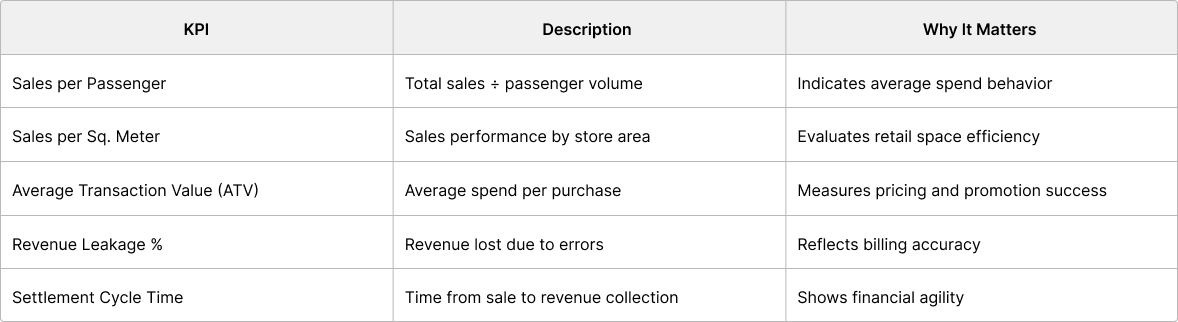
These KPIs, when monitored in real time, give executives the power to adjust operations proactively—rather than reactively.
Why It’s Critical for Airports in the USA, UK, and Australia
USA: Large hub airports handle hundreds of retail outlets and millions of transactions daily. Without automation, tracking performance becomes impossible. Real-time data capture provides instant oversight and unified control.
UK: Changing retail regulations and duty-free frameworks require precision in concessionaire billing. Real-time analytics ensures compliance, transparency, and audit-readiness.
Australia: Regional airports expanding their retail footprint can use real-time dashboards to scale operations efficiently and maintain control across terminals.
Across all three regions, Real-Time Sales Data Capture drives agility, accountability, and measurable revenue growth.
Real-World Example: Turning Data into Dollars
A leading international airport implemented a real-time sales data solution similar to StoreSense for Airport. Results achieved within six months:
- 15% improvement in revenue assurance through automated validation.
- Billing cycle reduced from 30 days to 5 days.
- Centralized visibility across 100+ concessionaires.
- Operational decisions made 60% faster. This proves the financial and operational ROI that real-time visibility can deliver.
Implementation Roadmap for Airport Leaders
- Assess Current Data Flows: Identify existing POS systems, integration gaps, and reporting delays.
- Select a Scalable Platform: Choose a system that supports multi-POS integration, real-time validation, and automated billing.
- Pilot & Validate: Start with one terminal or a select group of concessionaires to demonstrate impact.
- Roll Out Airport-Wide: Once validated, extend the solution across all outlets, terminals, and partner systems.
- Empower Teams: Train commercial, finance, and IT departments to leverage analytics dashboards effectively.
- Measure & Optimize: Continuously track KPIs and optimize operations based on real-time insights.
The Future: Predictive Airport Commerce
The evolution of airport retail analytics doesn’t stop at real time. With AI and machine learning, airports will soon predict:
- When specific product categories will peak.
- Which passenger demographics are most profitable.
- How to dynamically adjust promotions or pricing in-flight.
Predictive analytics will make airports not just data-driven—but data-empowered.
Key Takeaways
- Real-Time Sales Data Capture eliminates visibility gaps in concessionaire performance.
- It helps executives monitor KPIs, ensure billing accuracy, and increase non-aero revenue.
- Airports in USA, UK, and Australia can leverage these insights to stay competitive and profitable.
- Platforms like StoreSense for Airport deliver the integration, automation, and analytics needed to make it happen.
Frequently Asked Questions
1. How can airports boost non-aero revenue using real-time data? By adopting an integrated analytics platform that captures every sale in real time, standardizes it across systems, and turns it into actionable intelligence for commercial and finance teams.
2. What is Real-Time Sales Data Capture and why do airports need it? Real-Time Sales Data Capture automatically collects and consolidates every retail and F&B transaction across the airport as it happens. For airports, it eliminates manual reporting delays and gives executives live visibility into sales trends, concession performance, and non-aeronautical revenue — helping them make faster, data-backed decisions.
3. How does Real-Time Sales Data Capture increase non-aero revenues? By integrating every concessionaire’s POS data in real time, airports can monitor what sells best, when, and to which passenger segment. These insights enable smarter space allocation, targeted promotions, and accurate billing — directly boosting sales per passenger and overall non-aero revenue growth.
4. What are the biggest revenue challenges airports face without real-time data? Without real-time visibility, airports often face: inconsistent reporting from concessionaires, delayed settlements and billing disputes, revenue leakages due to manual errors, missed opportunities for demand-based pricing or promotions real-time data capture solves all these pain points by ensuring accuracy, transparency, and instant access to commercial insights.
5. Can airports integrate multiple POS systems using one platform? Yes. A platform like StoreSense for Airport connects with multiple POS systems across retail and F&B outlets using secure APIs, flat files, or SFTP channels. It standardizes data from diverse sources into one unified dashboard, ensuring smooth integration and complete visibility without disrupting existing operations.
6. What KPIs can airport executives track through Real-Time Sales Data Capture? Executives can monitor key performance indicators (KPIs) such as: sales per passenger, sales per square meter, average transaction value (ATV), revenue leakage percentage. Billing and settlement cycle time Tracking these metrics in real time helps optimize retail performance and improve commercial strategy.
7. How can airport executives get started with Real-Time Sales Data Capture? Start with a clear audit of current POS systems and reporting gaps. Then choose a scalable, secure solution like StoreSense that offers: multi-POS integration, real-time validation, automated concessionaire billing. After a pilot run in one terminal, roll out the system airport-wide and train teams to act on live analytics.

Airports are among the most complex operational ecosystems in the world. Every day, thousands of decisions are made from flight scheduling and baggage handling to passenger movement and cargo management. These decisions depend on information coming from dozens of systems: terminal operations, ground handling, weather, flight information, finance, HR, and more.
Yet in most airports, these systems don’t talk to each other. They collect massive amounts of data but that data sits in isolation, locked away in silos.
The result? Decision-making becomes reactive, slow, and fragmented. Teams operate in the dark, duplication of effort increases, and opportunities to optimize are missed.
In an industry where every minute matters, disconnected data is an invisible cost airports can no longer afford.
The Hidden Cost of Disconnection
At first glance, each airport system seems efficient on its own. The Flight Information Display System (FIDS) keeps passengers informed. The ground handling system manages baggage and turnaround times. Terminal operations software monitors check-ins and queues. Weather and air traffic systems handle safety and scheduling.
But here’s the problem: when these systems aren’t integrated, they create data silos isolated pockets of information that prevent a unified view of operations.
A ground delay might not automatically update in FIDS. A late baggage offload might not sync with flight departure data. Passenger surges might go unnoticed by HR planning or concession teams.
Understanding Data Silos in Airports
The result is like an orchestra where each musician plays perfectly but no one can hear the others.
A data silo forms when information is stored within one department or system and cannot easily be accessed by others.
In airports, common silos include:
- Terminal Operations Systems: Manage passenger flow, check-ins, gates, and queues.
- Ground Handling Systems: Oversee baggage, fueling, catering, and turnaround activities.
- Flight Information Display Systems (FIDS): Update flight schedules and public information.
- Weather and Air Traffic Systems: Impact runway availability and flight planning.
- Finance and HR Systems: Control budgeting, staffing, and payroll.
- Commercial and Retail Systems: Handle parking, retail sales, and non-aero revenues.
Each system serves its own purpose but when they operate in isolation, they restrict collaboration and prevent big-picture insights.
Why Non-Aero Revenue Is the Next Growth Engine for Airports
Airports around the world have entered a new phase of transformation. Beyond managing flights and passengers, they are now strategic commercial hubs—home to retail stores, restaurants, lounges, and entertainment experiences.
While aeronautical income remains steady, non-aeronautical revenue—from retail, F&B, parking, and advertising—is increasingly vital for profitability.
Yet, despite this potential, many airports still lack real-time visibility into how these revenue streams perform daily. Concessionaires submit sales data manually, reports arrive late, and executives are left making high-value decisions based on outdated information.
The result? Missed revenue opportunities, slow settlements, and limited control.
This is where Real-Time Sales Data Capture steps in. It enables airports to see every sale, every store, every minute—and turn that data into measurable growth.
The Pain Point: Blind Spots in Concession Sales
Every airport executive knows the frustration: You want to evaluate which stores are performing best, but by the time the data lands in your inbox, it’s already a week old.
Meanwhile:
- Promotions have ended
- Flight schedules have changed
- Passenger behaviors have shifted
The inability to view sales data as it happens leaves airports flying blind.
Common symptoms of this visibility gap include:
- Manual consolidation of concessionaire reports
- Errors and inconsistencies between vendors
- Long billing cycles and delayed settlements
- Undetected revenue leakages due to incorrect reporting
- Lack of actionable insights for decision-making
To compete effectively, airports need accurate, automated, and real-time data visibility—not after the fact, but as each transaction occurs.
What Is Real-Time Sales Data Capture?
Real-Time Sales Data Capture is the automated process of collecting transaction data from all retail and F&B concessionaires the moment a sale happens.
Instead of waiting for manual uploads or Excel files, the system integrates directly with concessionaire POS terminals through secure APIs, SFTP, or flat files, and standardizes data into a centralized BI dashboard.
In simple terms: It connects every cash register inside your airport to one unified data system—giving you live insights into sales, billing, and revenue across all outlets.
Imagine: At 10:00 a.m., a coffee shop sale is made at Terminal B. By 10:01, that transaction appears on your dashboard with accurate details: item, value, store, passenger segment, and more.
That’s the power of real-time.
How It Works: From Transaction to Insight
Here’s how modern airports implement real-time sales data capture systems (like GrayMatter’s StoreSense for Airport):
- Sale Data Integration: All concessionaires’ POS systems—regardless of type or vendor—connect to a secure ingestion layer.
- Sales Data Validation: The system automatically checks data quality, validates values, and eliminates duplicates or missing entries.
- Standardization: Data from various POS formats (XML, CSV, API) is unified into one standard schema.
- Real-Time Processing: Transactions are processed instantly and made visible through airport BI dashboards.
- Analytics & Insights: Executives can track key KPIs such as sales per passenger, sales per sqm, and average transaction value.
- Automated Billing: Contract terms (base rent, revenue share, thresholds) are applied automatically—enabling accurate concessionaire billing and faster settlements.
The Strategic Impact for Airport Executives
1. Improved Revenue Assurance
With every sale recorded instantly, there’s no room for human error. Automated validation ensures complete transparency, protecting airports from revenue leakage and dispute risks.
2. Data-Driven Commercial Strategy
Executives can now see which brands perform best by time, flight, or passenger type. These insights support smarter lease negotiations and retail mix planning.
3. Faster Financial Settlements
Automating billing through real-time data reduces manual work for finance teams and shortens settlement cycles from weeks to days.
4. Enhanced Passenger Experience
Understanding real-time purchase behavior helps tailor marketing and retail experiences—leading to increased satisfaction and spending.
5. Greater Vendor Trust
When concessionaires know the billing process is transparent and data-backed, relationships strengthen, creating a more collaborative environment.
These KPIs, when monitored in real time, give executives the power to adjust operations proactively—rather than reactively.
Why It’s Critical for Airports in the USA, UK, and Australia
USA: Large hub airports handle hundreds of retail outlets and millions of transactions daily. Without automation, tracking performance becomes impossible. Real-time data capture provides instant oversight and unified control.
UK: Changing retail regulations and duty-free frameworks require precision in concessionaire billing. Real-time analytics ensures compliance, transparency, and audit-readiness.
Australia: Regional airports expanding their retail footprint can use real-time dashboards to scale operations efficiently and maintain control across terminals.
Across all three regions, Real-Time Sales Data Capture drives agility, accountability, and measurable revenue growth.
Real-World Example: Turning Data into Dollars
A leading international airport implemented a real-time sales data solution similar to StoreSense for Airport.
Results achieved within six months:
- 15% improvement in revenue assurance through automated validation
- Billing cycle reduced from 30 days to 5 days
- Centralized visibility across 100+ concessionaires
- Operational decisions made 60% faster
This proves the financial and operational ROI that real-time visibility can deliver.
Implementation Roadmap for Airport Leaders
- Assess Current Data Flows: Identify existing POS systems, integration gaps, and reporting delays.
- Select a Scalable Platform: Choose a system that supports multi-POS integration, real-time validation, and automated billing.
- Pilot & Validate: Start with one terminal or a select group of concessionaires to demonstrate impact.
- Roll Out Airport-Wide: Once validated, extend the solution across all outlets, terminals, and partner systems.
- Empower Teams: Train commercial, finance, and IT departments to leverage analytics dashboards effectively.
- Measure & Optimize: Continuously track KPIs and optimize operations based on real-time insights.
The Future: Predictive Airport Commerce
The evolution of airport retail analytics doesn’t stop at real time. With AI and machine learning, airports will soon predict:
- When specific product categories will peak
- Which passenger demographics are most profitable
- How to dynamically adjust promotions or pricing in-flight
Predictive analytics will make airports not just data-driven—but data-empowered.
Key Takeaways
- Real-Time Sales Data Capture eliminates visibility gaps in concessionaire performance
- It helps executives monitor KPIs, ensure billing accuracy, and increase non-aero revenue
- Airports in USA, UK, and Australia can leverage these insights to stay competitive and profitable
- Platforms like StoreSense for Airport deliver the integration, automation, and analytics needed to make it happen
Frequently Asked Questions
1. How can airports boost non-aero revenue using real-time data?
By adopting an integrated analytics platform that captures every sale in real time, standardizes it across systems, and turns it into actionable intelligence for commercial and finance teams.
2. What is Real-Time Sales Data Capture and why do airports need it?
Real-Time Sales Data Capture automatically collects and consolidates every retail and F&B transaction across the airport as it happens. For airports, it eliminates manual reporting delays and gives executives live visibility into sales trends, concession performance, and non-aeronautical revenue—helping them make faster, data-backed decisions.
3. How does Real-Time Sales Data Capture increase non-aero revenues?
By integrating every concessionaire’s POS data in real time, airports can monitor what sells best, when, and to which passenger segment. These insights enable smarter space allocation, targeted promotions, and accurate billing—directly boosting sales per passenger and overall non-aero revenue growth.
4. What are the biggest revenue challenges airports face without real-time data?
- Inconsistent reporting from concessionaires
- Delayed settlements and billing disputes
- Revenue leakages due to manual errors
- Missed opportunities for demand-based pricing or promotions
Real-time data capture solves all these pain points by ensuring accuracy, transparency, and instant access to commercial insights.
5. Can airports integrate multiple POS systems using one platform?
Yes. A platform like StoreSense for Airport connects with multiple POS systems across retail and F&B outlets using secure APIs, flat files, or SFTP channels. It standardizes data from diverse sources into one unified dashboard, ensuring smooth integration and complete visibility without disrupting existing operations.
6. What KPIs can airport executives track through Real-Time Sales Data Capture?
- Sales per passenger
- Sales per square meter
- Average transaction value (ATV)
- Revenue leakage percentage
- Billing and settlement cycle time
Tracking these metrics in real time helps optimize retail performance and improve commercial strategy.
7. How can airport executives get started with Real-Time Sales Data Capture?
Start with a clear audit of current POS systems and reporting gaps. Then choose a scalable, secure solution like StoreSense that offers multi-POS integration, real-time validation, and automated concessionaire billing. After a pilot run in one terminal, roll out the system airport-wide and train teams to act on live analytics.